
GLOSSARY
Sustainable Cladding: What Really Makes a Facade Sustainable?

What is sustainable cladding?
Sustainable cladding is cladding that lasts at least 25 years without chemical treatment or replacement, requires little maintenance and is made from materials with a low ecological footprint. Charred wood is a good example. Within this, two concepts can be distinguished. Technical durability is about lifespan: how long does the material hold up outdoors without rotting, deforming or losing its protective function? Ecological sustainability is about the environmental impact of production, use and processing. The most sustainable cladding scores well on both fronts, such as charred wood.
Durability classes: the basis for a good material choice
Within Europe, wood species are classified based on their resistance to fungi and rot, according to EN 350. That classification runs from class 1, more than 25 years of outdoor use without treatment, to class 5, not suitable for outdoors. Douglas and larch naturally fall into class 3. Untreated pine sits in class 4 and is not suitable for facades without impregnation.
Thermal modification and controlled surface charring lift wood to class 1. The char layer that forms seals off the outer fibres, keeps out moisture and UV radiation, and increases fire safety to class B s1 d0 according to EN 13501, without chemicals, using only fire and precision.
Sustainable wood cladding: ecological impact
Wood stores CO2 during growth and only releases it at the end of its life cycle. Provided it comes from certified sources, FSC or PEFC, it actively contributes to a lower CO2 footprint. Over the full life cycle, wood generally scores better in an LCA than concrete, steel or plastic.
Sustainable and circular cladding
Circular cladding is material that is reusable or biodegradable at the end of its lifespan. Wood that has not been chemically impregnated meets this criterion: no microplastics, no coatings with heavy metals, no processing problems.
Most sustainable cladding: a comparison
The charred surface forms a natural protective layer against moisture, fungi and insects. No chemicals, minimal maintenance and a lifespan of 80 years or more.
Thermally modified wood
Wood treated under high temperature for a more stable cell structure and higher resistance to fungi. Periodic oiling is recommended for colour retention.
Western red cedar
One of the most naturally durable wood species, with good resistance to rot and insects. Does require maintenance every 3 to 5 years, however.
Corten steel
Steel that deliberately oxidises and thereby protects itself against further corrosion. Practically maintenance-free, but production has a high environmental impact.
Brick and facing brick
Extremely long lifespan, virtually no maintenance and easily reusable as reclaimed brick. Production through the firing process has a high CO2 output.
For those choosing sustainable wood cladding with minimal maintenance and maximum ecological value, charred wood is the most complete solution. Get in touch for free advice on your project.
Frequently asked questions
What is the most sustainable cladding?
On technical lifespan, Accoya scores highest. On the combination of lifespan, ecological impact and low-maintenance character, charred wood performs strongest.
Is sustainable wood cladding also maintenance-free?
Not entirely, but charred wood comes close. The char layer protects without additional coatings. Periodic cleaning is enough. Painting or staining is not needed.
What is sustainable and circular cladding?
Cladding that is reusable or biodegradable without harmful residues at the end of its lifespan. Wood without chemical impregnation meets this criterion.
How long does sustainable wood cladding last?
Charred wood and thermally modified wood species last 25 years or more. Accoya has a guaranteed lifespan of more than fifty years. The exact lifespan depends on installation method, ventilation and location.
View the products: Burned Wood Accoya, Burned Wood Douglas, all products
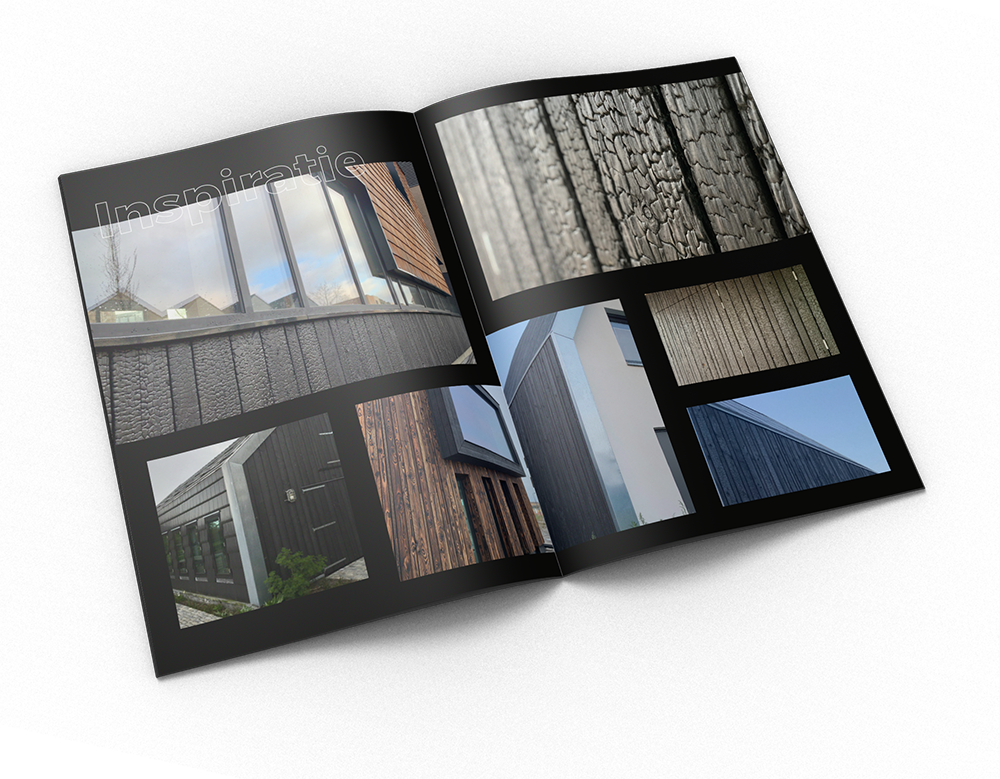
BROCHURE
Download our digital brochure
In our digital brochure you will find more inspiration, information about our products and prices.


